As part of ZEFAK collective (Aria Farajnezhad, Elard Lukaczik, Zainab Haidary)
Futurearchives emerged from an intensive inquiry into how to reconcile the tension between the particular and the universal through practices of solidarity across different causes. It engages with local struggles and problematics while investigating how they are constituted across time and space, beyond the limits of localism or an over-identification with one’s own suffering. It asks how to navigate exceptionalism within anthropocentric discourse by engaging anti-colonial thinkers and searching for notions of futurity that inform the present, especially in relation to the distribution of knowledge and resources.
The collective spent its first months at Künstlerhäuser Worpswede, where, supported by a one-year fellowship, it laid the foundations for this project series through the writing of a manifesto. Below you will find a selection of projects developed during the years the collective was active.
- It doesn’t have to be concrete yet, July 2022
- Where the River resides, December 2021
- Another Way of Arrival, April 2021
- Calling the future Symposium, August 2020
It doesn’t have to be concrete yet, July 2022
Story telling event as part of the Osten Festival in Bitterfeld
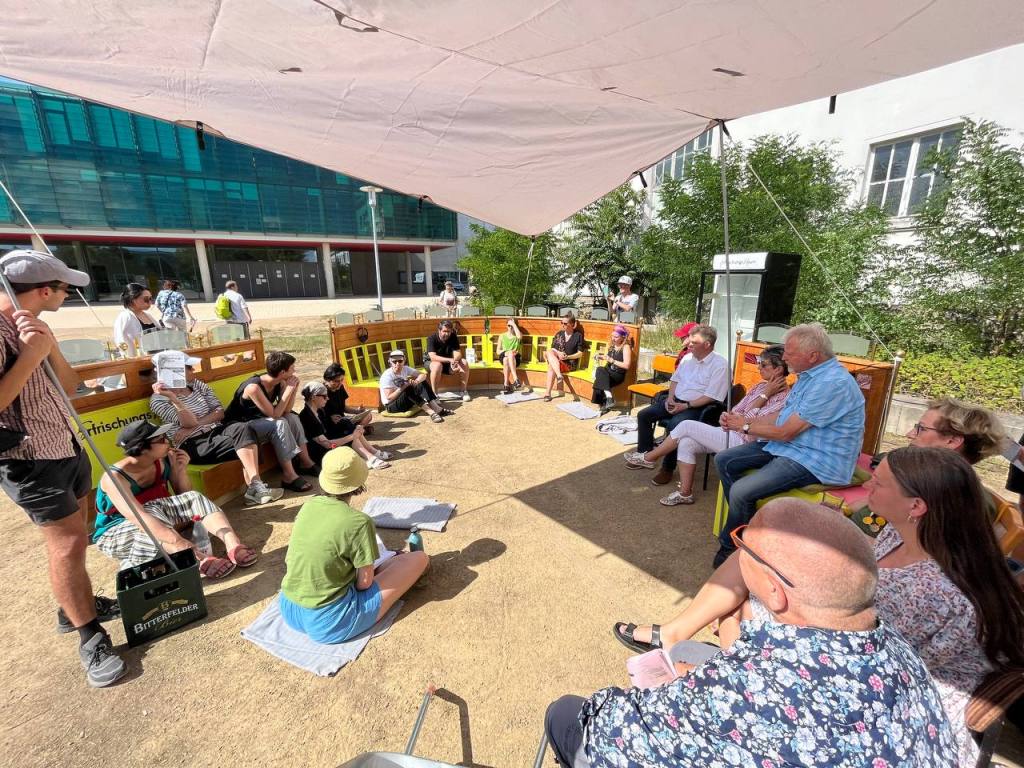
At the Osten Festival in Bitterfeld, we created a very intimate environment in which we, as invited artists, members of the curatorial team, and a vulnerable local community, shared personal stories addressing political issues that deeply affect our lives. Many of these narratives only became articulable after we had listened to recordings of interviews with witnesses from Bitterfeld who entrusted us with their testimonies.
The text was written to foreground the tension between immediate lived experiences and the broader contexts that mediate and co-constitute them. One of our stories was divided into three chapters—steel, sugar cane, and oil—as three materials that shape the region geographically, impact the lives of its inhabitants, and therefore inform their immediate experiences.
The other story complicated a linear understanding of time that is fixated on a single location, showing how this perspective breaks apart once we begin to register experience trans-locally and to consider planetary coexistence.
Where the River resides, December 2021
Exhibition at MM,M and talk at Stadtgalerie Saarbrücken
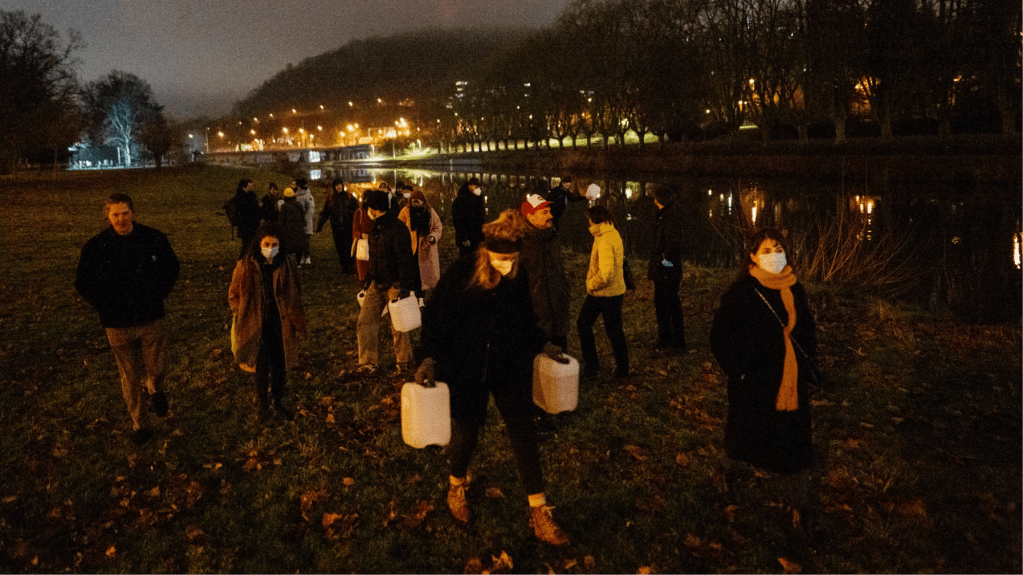
ZEFAK have made water as a resource and old mining tunnels – the history as well as the future of resource extraction – their subject in Where the River resides. Zainab Haidary in one of Philip Majer’s videos on ZEFAK’s work: “We care about being involved in what is happening here. When you are involved, there is always a way to interact with each other or to find a solution together. Or how can we develop things around a discourse in different ways, for example, how can we, as artists, contribute to this issue?”
Their approach and work have led to a strong sense of involvement from a wide range of visitors and participants. Participation also came about through different events.
The finissage started in front of the workspace window with a last look at the work Where the River resides. Together, the pit water from the waterfall was pumped into canisters. All visitors were given a canister and walked in small groups. ZEFAK distributed 5 questions to each group on the topic of “being affected”. The person carrying the canister answered these questions on the way to the Saar. The participants could also swap, carry canisters and answer questions or simply listen. The water was then returned to the Saar. Afterwards, Philipp Majer’s final video contribution to the project was shown in the event room of the Stadtgalerie Saarbrücken and there was further exchange. With this final moment of returning the water together, ZEFAK affected us all and connected us with the water.*
* excerpt from the text “what becomes visible” by Katharina Ritter.

Another Way of Arrival, April 2021
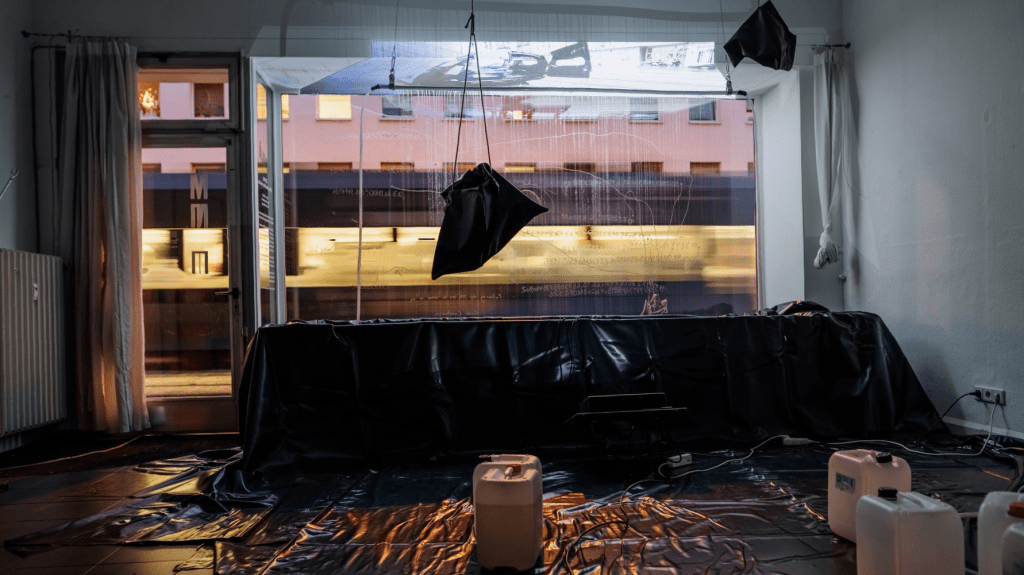
Video Work shown at the Association for Art History’s Annual Conference 2021

In their contribution to the Association for Art History’s Annual Conference 2021 in the UK, ZEFAK advocated for the recognition of non-disciplinary practices within traditional art history. Through an introductory presentation entitled We want everything “neerg” back, the collective called for urgent intervention, reparations, and compensation within the art world and beyond. Following this performative piece, they presented the video essay Another Way of Arrival (2021), in which green functions both as a visual element and as a pathway to meaning. Through the satirical and metaphorical language that runs across their works, ZEFAK invites audiences to reflect on the thorny questions of history and representation. *
* contributed by Azadeh Sarjougian
Calling the future Symposium, August 2020
Symposium at Künstlerhäuser Worpswede
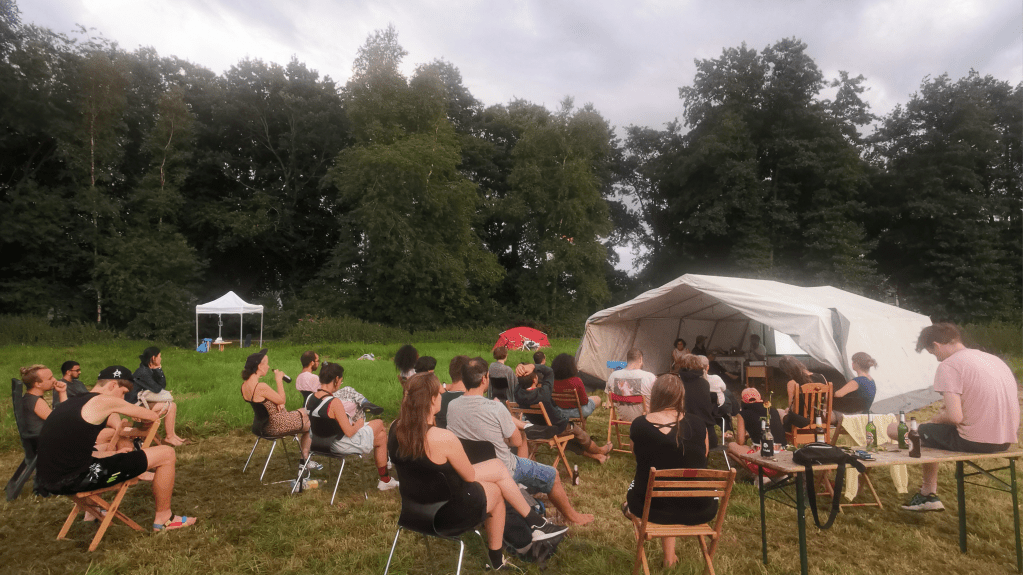
In April 2020, the collective (Aria Farajnezhad, Elard Lukaczik, and Zainab Haidary) was awarded a residency scholarship at Künstlerhäuser Worpswede. This resulted into putting together a 3-days Symposium Calling the future, here you can find the links to the program and a selection of the lectures and workshops which were organized by the collective.
Deploying diverse strategies and hybrid methods there, ZEFAK created a space to navigate temporal and spatial negotiations around justice in its broadest sense, destabilising dichotomies such as self/other, human/non-human, and culture/nature. The collective’s practice consists of writing, performing, and animating critical reflections on current global power structures; reshaping institutional spaces and providing interdisciplinary platforms for local artists, activists, and researchers to engage in unfamiliar dialogues on familiar subjects; and documenting, archiving, and sharing resources online to captivate a potential translocal audience with an ongoing imagination, allowing conversations about a just future to take place.*
* contributed by Azadeh Sarjougian
 Aria Farajnezhad