The initial inquiry arose from a need to reflect on false self-perception within modern nation-state building and its built-in apparatuses of othering. This trajectory critically questions the demand for a unified, coherent self-image imposed by nationalist narratives and their insistence on visibility and legibility. Instead, it turns toward submergence and fragmentation as conditions that might open space for other forms of relation—relations that have long existed beneath the surface of official histories and their fetishization of exposure and absolute identification.
How to Abolish a Name, March 2025
Video, 12′ 48″
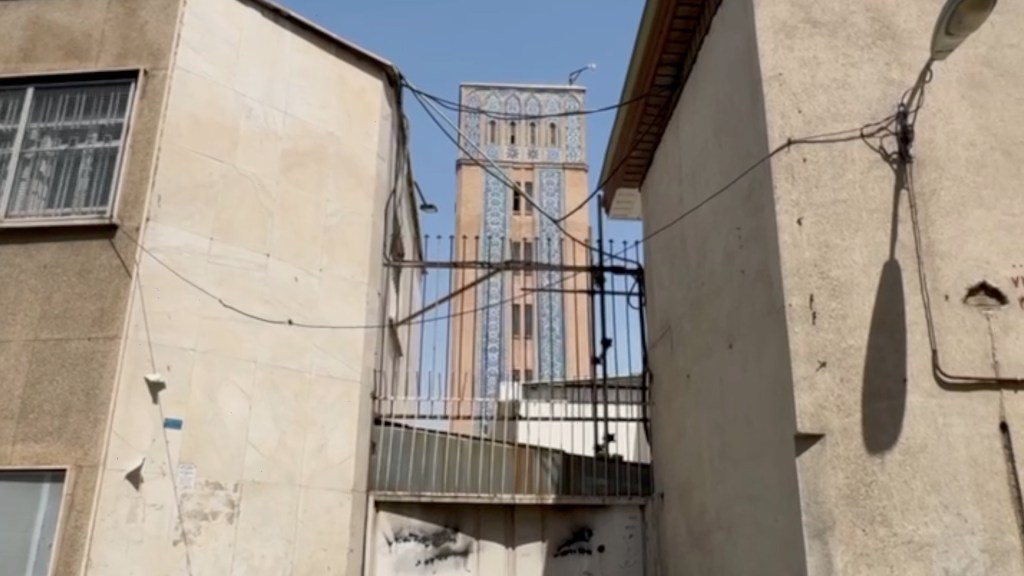
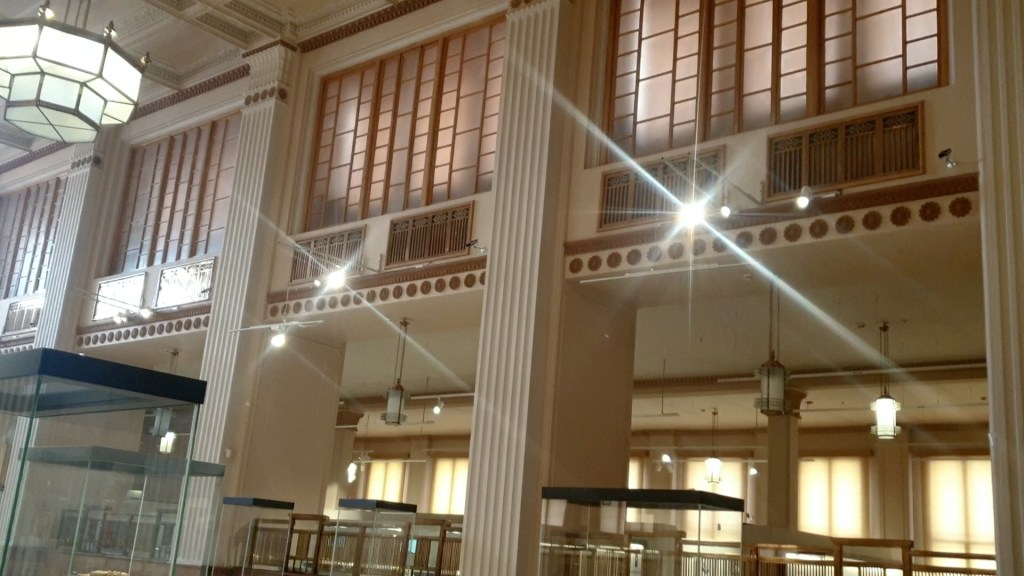
The film explores one of Iran’s first National Bank buildings, designed by German architect H. Heinrich in 1928 and later turned into a museum in 2017.
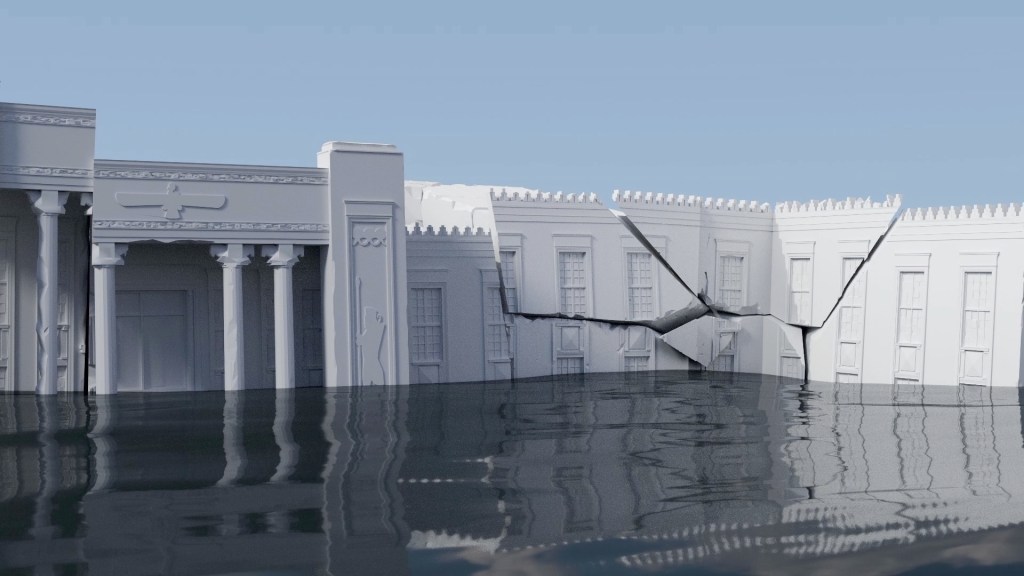
The filmmaker’s mother films its interior and water tower, attributed to Kurt Lindenblatt, the bank’s first director. How to Abolish a Name blends animation with documentary footage to imagine a flood emanating from the water tower that unsettles the building’s rigid temporality—emblematic of the Pahlavi-era nation-state building project and its lasting echoes today.

3d modeling:
Farzad Golghasemi, Nicoló Cervello
3d animation:
Nicoló Cervello
Camera:
Lida Ghaderpanah, Negar Hejazi
Thanks to:
Dorsa Eidizadeh, Lida Ghaderpanah, Natascha Sadr Haghighian, Abdur Rehman Zafar, Ruben Hordijk, Alina Achenbach, Sabine Broeck, Saleh Abdelaziz, Bleen Abraham, Josias Tembo, Steven Cuzner, Jukka Boehm
Supported by the Filmbüro Bremen with funds from nordmedia – Film- und Mediengesellschaft Niedersachsen/Bremen mbH
IM, April 2024
Group Exhibition at Bremen Haus der Bürgerschaft
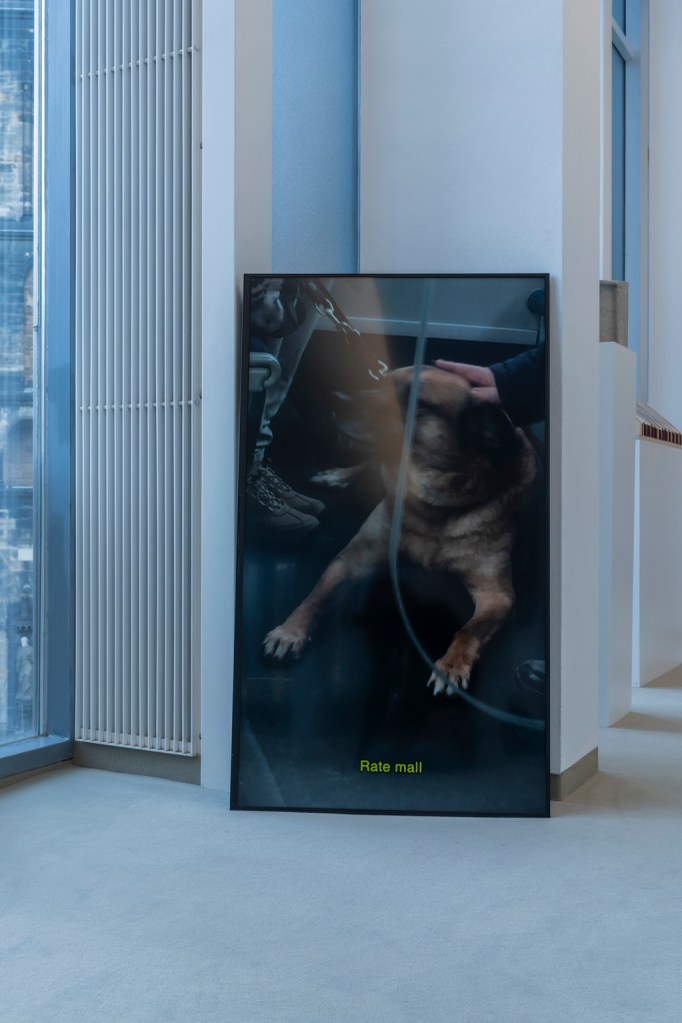
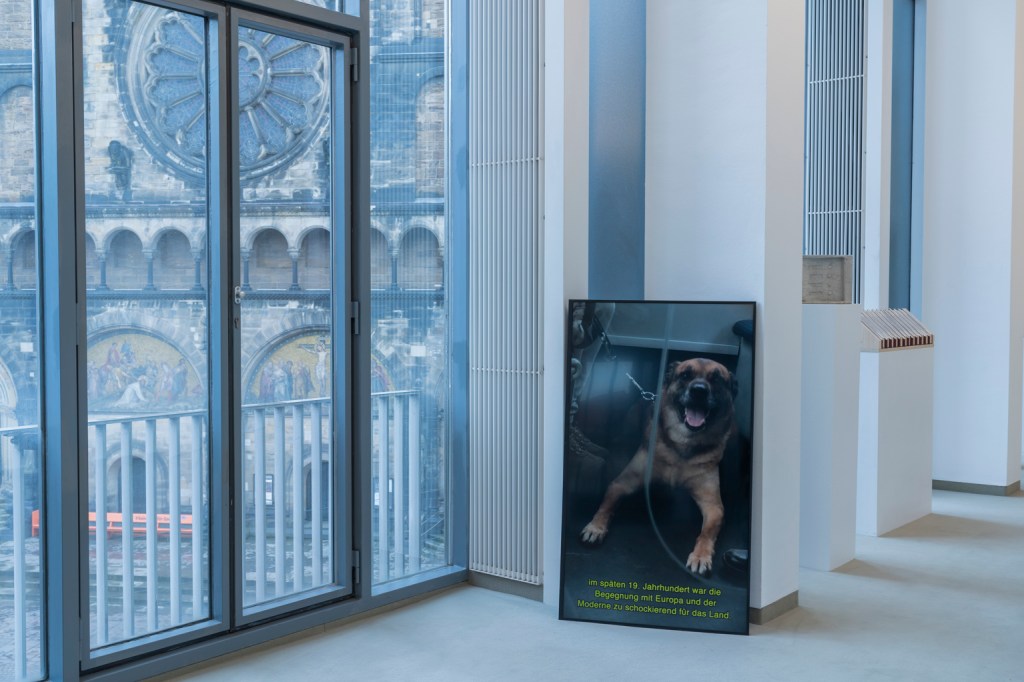
IM (Instant Message / I am) is a 2½-minute video shot on a tram in Bremen, following an anxious dog as a disembodied hand occasionally enters the frame to pet it.
The subtitles trace how modern Iranian nationalism forged a racial/cultural proximity to Europe by scapegoating Arabs, importing German Aryanist fantasies, and romanticizing a unified pre-Islamic “golden age.” This ideology has justified the minoritization of non-Persian peoples and languages and even state control over which names can be registered.
IM focuses on the name Aria as a condensed site of these histories: at once a nationalist aspiration and a racialized demand to identify with the perpetrator. The video stages the author’s dilemma of how to abolish their name while remaining a historical subject, mirrored in the paternalistic care directed at the domesticated, visibly unsettled dog.
The work was shown at the Bremen Haus der Bürgerschaft as part of a group exhibition that critically examined HfK Bremen’s role as an art school during the Nazi era, particularly in relation to aesthetics and representation. Students and alumni of the Fine Arts program contributed works that did not necessarily address this history directly, but resonated with it across different registers.
I just wanted to tell you what I found out lately about my name.
I was always very skeptical about it, but now I understand the reason.
it is just an accumulation of false self-perception.
guess what? it is an European import, began with linguistic, then racial anthropology and result into catastrophe.
you know it is an outcome of a nationalistic discourse.
in the late 19th century the encounter with Europe and modernity was too shocking for the country.
so the Idea was to sympathize with the European peers. to write a racial history as if the geographical distance just accidentally happened.
to be able to compensate for the traumatic feeling of loss of and shortcoming.
the romantic german author Friedrich Schlegel has appropriated the term Ariya by suggesting that Vedic and Avestan ariya are related to Germanic Ehre (honor), enabled the Aryianism discourse which later led into the Nazi murderous camps.
they might not have expected, that we would rediscover it later and pretend as if it has been always existed.
it is horrible: I don’t know what to do, maybe I should dispute my name, but how can I demolish my name and stay a historical subject..
Absorbing properties – part one, Feb 2020
Group Exhibition at Medienfassade der HBKsaar Galerie
Responding to the shift from in-person collaboration to fragmented online encounters, the project explored distance, interruption, and miscommunication through image cuts, echoes, and glitches. An accompanying asynchronous sound piece was accessible via a QR code on site or online. The project grew out of a partnership with students of HBKsaar’s MA in Curating and Exhibition Studies, with further editions planned.
Absorbing Properties was my contribution to this intervention on the building’s façade. In contrast to the immersive sound you hear when you approach the waterfall/dam in Bremen, passers-by encountered an enlarged projection of water pressure that enveloped the building in silence—leaving space to imagine how to tune into the impossible.
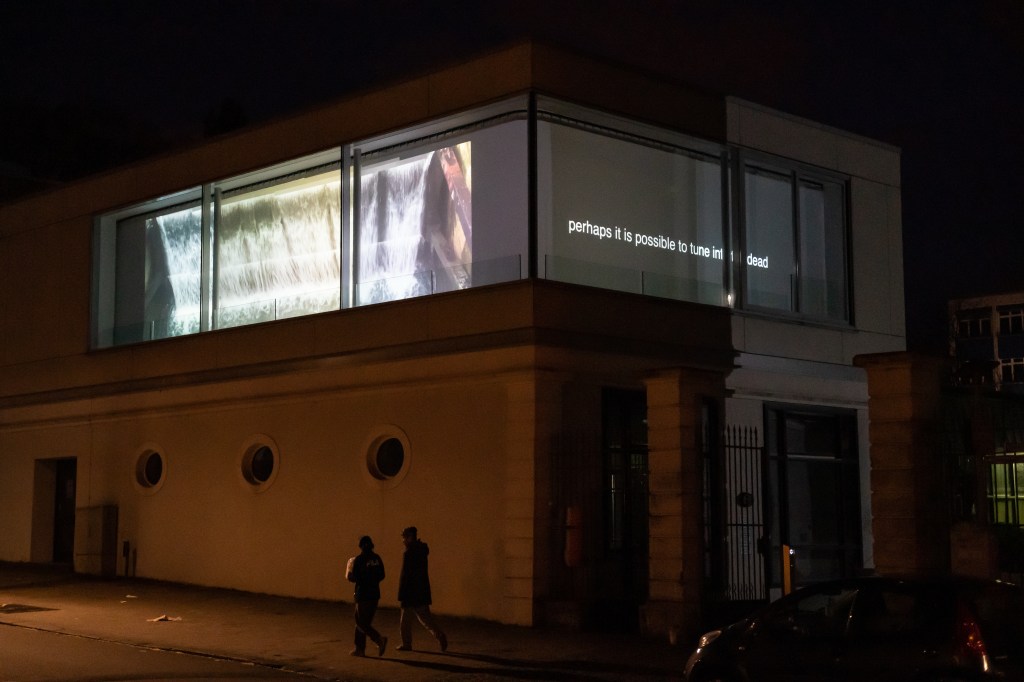
, Medienfassade der HBKsaar Galerie, 2020.
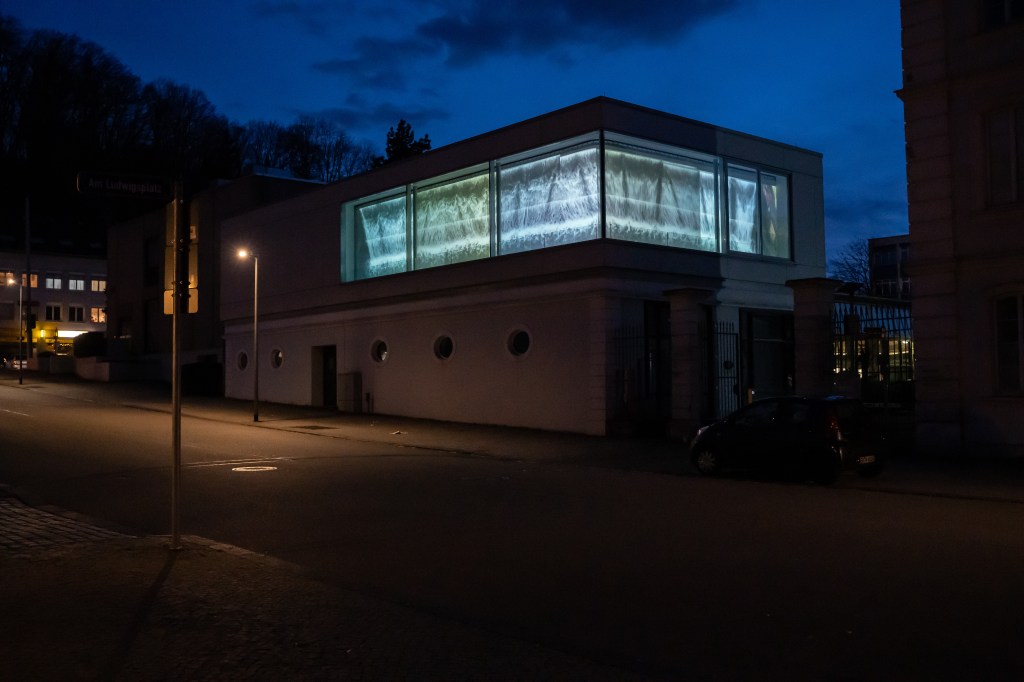
, Medienfassade der HBKsaar Galerie, 2020.
Perhaps it is possible to tune into the imminent
Perhaps it is possible to tune into the dead
Perhaps it is possible to tune into into yet to come
 Aria Farajnezhad